North Carolina Steakhouses | SteakMap
The Best Steakhouses in North Carolina
North Carolina is the only state in this directory where no single city runs away with it. Charlotte holds 13 steakhouses, Raleigh 8, Greensboro 5 — and the other 40 are spread across 29 more towns: mountain lodges above 3,000 feet, Outer Banks beach roads, Lake Norman docks, and 1880s main streets in old furniture and textile towns. 66 steakhouses, 32 cities. This is a state you eat across rather than in.
It is also a state that made its name on pork. Whole-hog barbecue is the North Carolina food story every visitor arrives knowing. The beef story is quieter, older than most people assume, and it produced one of the three or four most decorated steakhouses in the American South.
The North Carolina Ten
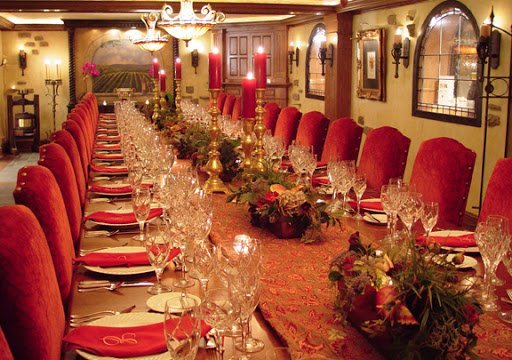
- Angus Barn (Raleigh) — the benchmark for the whole state, and arguably the whole Southeast. A genuine red barn serving roughly 22,000 steaks a month, with a wine cellar holding more than 25,000 bottles. Open 363 nights a year.
- Kau (Greensboro) — butcher-owned, which is the detail that matters. Black Angus Prime is cut in the on-site butcher market and walked into the kitchen. Set under the rafters of Revolution Mill, a restored flannel mill from Greensboro’s textile century.
- Bin 54 Steak & Cellar (Chapel Hill) — aged USDA Prime and Certified Angus, and the one order to build a night around is the dry-aged bone-in ribeye. A working wine cellar doubles as the private room.
- Steak 48 (Charlotte) — master butchers hand-cut 28-day wet-aged beef, finished in an 1,800-degree broiler. The most technically precise cooking in the city.
- Oak Steakhouse (Charlotte) — the deepest aging list in North Carolina on one menu: dry-aged New York strip and dry-aged bone-in ribeye alongside hanger, Prime strip, tomahawk and A5. Also in Raleigh and, improbably, in Highlands at 4,100 feet.
- Dean’s Italian Steakhouse (Charlotte) — Prime beef and 100% American Wagyu against a menu of handmade pasta. Chateaubriand, barrel-cut filet, bone-in ribeye, A5.
- The Peddler Steak House (Raleigh) — open since 1969, and the last widely surviving example of the tableside meat cart: the cart is wheeled over, you pick the cut and the thickness, and it is trimmed in front of you. Aged 28 days, grilled over live charcoal. The mountain sibling in Boone does the same thing.
- Peninsula Prime (Cornelius) — Lake Norman’s best steak. Hand-cut Prime, Japanese Wagyu, and a 48-ounce tomahawk built for two.
- Rye Knot (Asheville) — steaks aged in-house and hand-cut, sold by actual weight rather than nominal size, inside a veteran-owned pub that runs the first combined brewery and distillery in North Carolina.
- Epic Chophouse (Mooresville) — an independent New York-style chophouse in an 1888 building on Main Street, running Prime and top Choice Midwestern corn-fed beef aged a minimum of 35 days. A Greensboro location followed.
In 1959, two groups bought the same cheap farmland. Only one expected to succeed.
In 1959 Governor Luther Hodges, working with the presidents of Duke, NC State and UNC and a group of industrialists, began quietly buying up 4,400 acres of pine woods and worn-out farmland in the empty middle between Raleigh, Durham and Chapel Hill. They bought it through a shell company called Pineland, Inc. so prices would not spike. The plan was to give the three universities somewhere to keep their graduates from leaving the state. It was formally established that year as Research Triangle Park, and it now covers 7,000 acres with more than 300 companies and roughly 65,000 workers.
That same year, on the same blank stretch of Highway 70 between Raleigh and Durham, two men in their twenties named Thad Eure, Jr. and Charles Winston bought 50 acres of cow pasture to build a steakhouse. Nobody thought it was a good idea. No bank would lend them the money — the location was considered too rural to work — so they borrowed from everyone they knew who had any faith in them at all, and built a barn.
The doors opened on June 28, 1960. Eure’s ambition was to build a wine list that could stand against California, which in 1960 North Carolina was an absurd thing to want. In 1989 Wine Spectator gave the Angus Barn its Grand Award, the magazine’s highest honor and one held by only a hundred-odd restaurants on earth — and then gave it again every year for more than two decades. The cellar passed 25,000 bottles.
By the 60th anniversary the barn had served roughly 14 million guests. It is run today by Van Eure, the founder’s daughter. The bet the banks refused to finance is now a landmark, and the pasture it was built on became one of the densest concentrations of research scientists in the United States.
Where to look beyond the three big cities
The mountains are the surprise. Sunset Terrace is an open-air chophouse on the granite terrace of the 1913 Grove Park Inn, facing west over the Blue Ridge — a ten-time Wine Spectator Award of Excellence winner, and seasonal, so check before you drive. Stonewalls anchors Banner Elk in ski country.
In the Piedmont, Charolais Steakhouse in Hickory is named after the French cattle breed; Spotted Cow serves Winston-Salem, Three Bulls covers Clemmons, and Vinnie’s Steak House & Tavern is the old-guard Raleigh room locals name second after the Barn. On the coast, G Prime Steak & Cellar handles Wilmington and JK’s has cooked over mesquite on the Outer Banks for decades. Around Lake Norman, Choplin’s and Charlotte’s Link & Pin round out the local side.
Most of the beef in the paragraphs above was raised in the Midwest and moved east — a supply chain that was invented, quite literally, in the Chicago stockyards.
The national chains
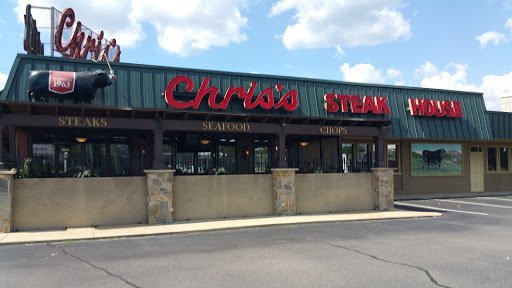
North Carolina carries a heavy national presence, and Charlotte and Raleigh have almost all of it. These rooms are reliable and usually very good — they are simply not specific to North Carolina, which is why they sit here rather than above. Ruth’s Chris alone runs seven locations in the state, from Cary to Cherokee. Fleming’s has three. Charlotte adds Del Frisco’s Double Eagle, Morton’s, Eddie V’s, STK, Sullivan’s and The Palm.
Browse the full state by city: Charlotte, Raleigh, Greensboro and Asheville.
Sorry, no records were found. Please adjust your search criteria and try again.
Sorry, unable to load the Maps API.